how to grind coffee beans without a grinder
This short guide helps you make fresh grounds using common kitchen tools when a grinder is out of reach. It’s aimed at apartment dwellers, travelers, new home hobbyists, and anyone whose grinder failed at the last minute in the United States.
Expect a solid cup, but know the tradeoff: consistency will suffer and that can change flavor clarity and extraction. A burr unit still gives the best control, but practical alternatives work in a pinch.
Later sections show blender, food processor, rolling pin, hammer-style crushing, and mortar and pestle options. You’ll get quick setup tips, mess control, and when each approach is best for your brew.
This method-first article focuses on fast, usable steps rather than deep theory. For a more detailed guide and extra tips, see our detailed guide.
Why grinding matters for fresh coffee flavor and extraction</h2>
Grinding changes surface area, and that shift in surface drives extraction and flavor balance.
Whole beans won’t release much taste in a normal brew time. Breaking the roast into particles gives water more contact area. That lets soluble oils and acids move into the cup faster.
Surface area and brew time
Smaller particles expose more surface, so extraction happens quicker. Large particles need more time and may under-extract. That means a weak, thin tasting cup when brew time is short.
Coarse vs. fine: simple comparisons
Think coarse like kosher salt and fine like table salt. Coarse particles extract slowly. Fine particles extract fast and can taste intense or bitter if over-extracted.
Match size with your method
- French press: coarse for even immersion.
- Pour-over: medium for balanced flow and clarity.
- Espresso: fine for pressure-based extraction.
DIY methods often yield mixed particle sizes. That unevenness causes patchy extraction and odd flavors. The main challenge is achieving a consistent grind, which we address next.
Before you start: prep, portioning, and what “consistent grind” really means</h2>
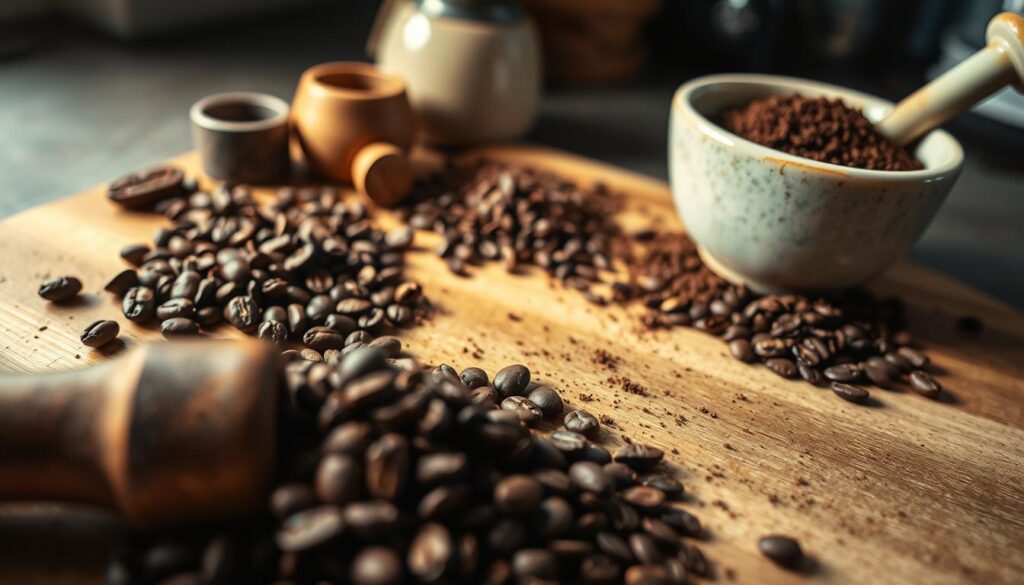
A quick setup and a clear plan will help produce more even particles and less mess at the counter.
How much to grind at a time for better results and less mess
Grind only what you need for the next cup coffee. Smaller portions are easier to control and cut cleanup time.
Measure with a spoon and work in 1–2 cup batches rather than dumping the whole bag on the counter. Ground coffee stales faster than whole coffee beans, so fresh is best.
How to avoid overheating beans when using kitchen appliances
Heat from blades can push oils out and make the cup bitter. Use short pulses—about 3 seconds—then pause.
After each set of pulses, tilt or shake the container so pieces redistribute. Repeat until the particle size looks even enough for your brew.
Simple tools that help: a zip-top bag, towel, sieve, and measuring spoon
- Zip-top bag: contains shards and protects surfaces during crushing.
- Towel: prevents slipping and cushions the countertop.
- Sieve: sifts out ultra-fines that cause bitterness.
- Measuring spoon: gives repeatable dosing for better results.
Safety note: keep lids secured on appliances, protect your hand when pressing or pounding, and wipe surfaces quickly so old aromas don’t linger.
How to grind coffee beans without a grinder using a blender or food processor</h2>
Blenders and food processors offer a practical path from whole roast to coarse ground for forgiving brew methods. Both appliances work best when you aim for coarser particles rather than espresso-fine dust.
Blender method: pulse, shake, and aim for a coarser grind
Measure the amount for one cup. Add beans to the jar and lock the lid. Use medium-high or the grinder setting in short pulses of about three seconds.
After several pulses, gently shake the jar so larger pieces fall toward the blades. Stop when you reach the desired consistency and avoid over-processing.
Food processor approach and why it can be a bit more even
Use the same pulse rhythm in the wider bowl. The extra space lets beans tumble, so fewer pieces hide away from the blade path.
A processor often handles slightly larger batches and gives a marginally more even result than a blade-style blender.
Sifting trick and best brewing matches
Pour grounds through a fine sieve. Set aside the extra-fine dust. Brewing with the coarser fraction cuts bitterness and evens extraction.
Appliance-ground coffee works best for cold brew and French press. Avoid relying on these methods for espresso; they rarely hit consistent espresso grind size.
| Appliance | Best target | Batch tip | Cleanup |
|---|---|---|---|
| Blender | Coarse / medium-coarse | Small batches, pulse + shake | Wash jar promptly to avoid lingering aroma |
| Food processor | Coarse, slightly more even | Use larger batch for efficient tumbling | Remove any stuck grounds and rinse |
| Blade grinder (comparison) | Variable; often uneven | Short bursts, sift if needed | Clean blades and lid immediately |
Manual kitchen hacks for grinding beans when you’re in a pinch</h2>
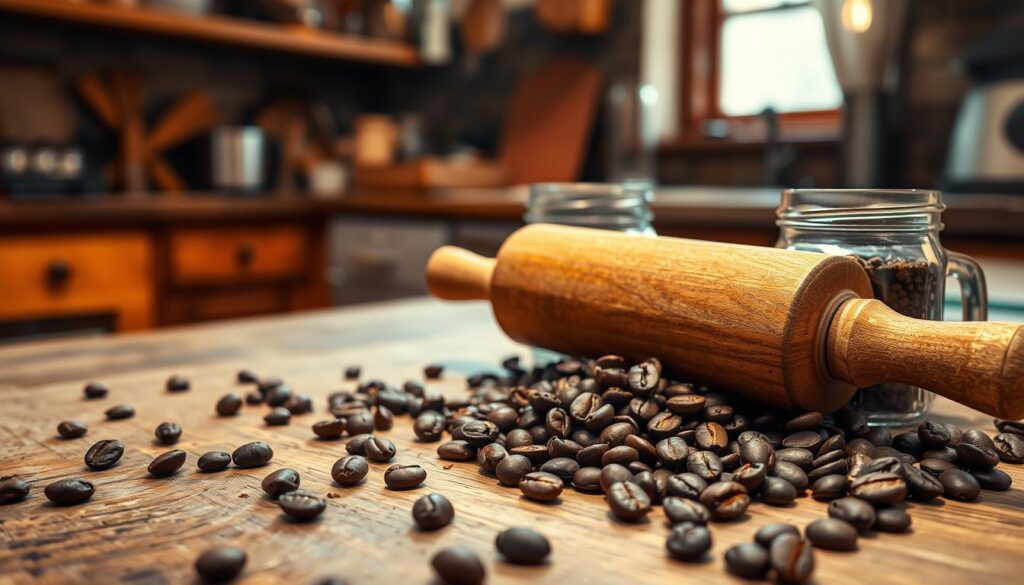
In emergencies, manual kitchen hacks deliver workable particles for forgiving brew methods like immersion. These approaches work well if appliances are unavailable, you are camping, or the power is out.
Rolling pin technique: crush first, then roll
Place roast in a sturdy zip-top bag and push out most of the air. Seal and give the bag a few quick crushes to break big pieces.
Next, use a rolling pin with firm, even pressure. Roll back and forth until the texture moves toward coarse or medium-coarse. Shake the bag so fragments move to the center and repeat.
Hammer method: steady taps, not wild swings
Use a thick cutting board and double-bag thin plastic. Tap gently with a hammer or mallet, pausing to check particle size. Reposition the contents so no large pieces remain.
Bag and surface tips to prevent mess and damage
- Double-bag if plastic feels thin.
- Keep one hand away from the impact zone.
- Protect counters with a towel and a heavy board.
| Method | Control | Best match |
|---|---|---|
| Rolling pin | Good — two-phase crush + roll | French press, cold brew |
| Hammer | Fair — more uneven, watch for shards | Immersion brews |
| Surface prep | Prevents damage and slipping | Any manual method |
Expect mixed particle sizes; pick immersion methods that tolerate variation. Stop when granules look fairly uniform and avoid creating fine dust unless your brew really needs it.
Mortar and pestle grinding for more control over grind size</h2>
A mortar and pestle offers the most hands-on control among manual options. You decide when particles are coarse or fine by feel rather than guessing at blade pulses.
Why this method can move from coarse to very fine
Crushing then rubbing lets you reduce particle size in stages. With patience, the same tool can produce coarse chunks for immersion or a much finer texture for drip.
Step-by-step motion for even results
Fill the mortar about one-quarter full so pieces can tumble and not spill. Start by pressing down to crack whole beans, then switch to circular grinding motions that shear and reduce size evenly.
Checkpoints, batching, and cleanup
Pause every 15–20 seconds and inspect for large chunks. Work small batches and combine them for a more consistent grind across the final grounds.
- Batch tip: several small loads beat one large pile for uniformity.
- Brewing match: coarse for immersion, medium for pour-over, finer if you have patience; espresso remain difficult.
- Cleanup: brush out oils right away to avoid aroma transfer to other spices.
| Step | Action | Why it helps |
|---|---|---|
| Load | One-quarter full | Room to move and even abrasion |
| Crack | Press then tap | Breaks large pieces quickly |
| Grind | Circular motion, pause and check | Smoother particle reduction and consistent grind |
Expect this approach to take more time than appliances. The payoff is cleaner control over grind size and a better final cup when consistency matters.
A better cup next time: when to choose a coffee grinder and how to store grounds</h2>
For regular home brewing, a dedicated coffee grinder quickly becomes the simplest route to more consistent cups.
Burr grinders give steady particle sizes, while blade and improvised methods often leave mixed fragments. That unevenness alters extraction and can mute sweet notes or bring out bitter edges.
Match your choice to habit: coarse settings for French press, adjustable mills for pour-over and drip, and finer capability if you make espresso often. Baratza is a commonly recommended line that covers many budgets.
Store ground coffee in an airtight container away from heat, sun, and moisture. Whenever possible, grind only the beans needed right before brewing. DIY methods are great backups, but for a clearer, repeatable cup this approach pays off.